Chemical Weather Forecasting & Urban PM2.5 Source Apportionment
Regional Chemical Weather Models & Beijing PM2.5 PMF Apportionment
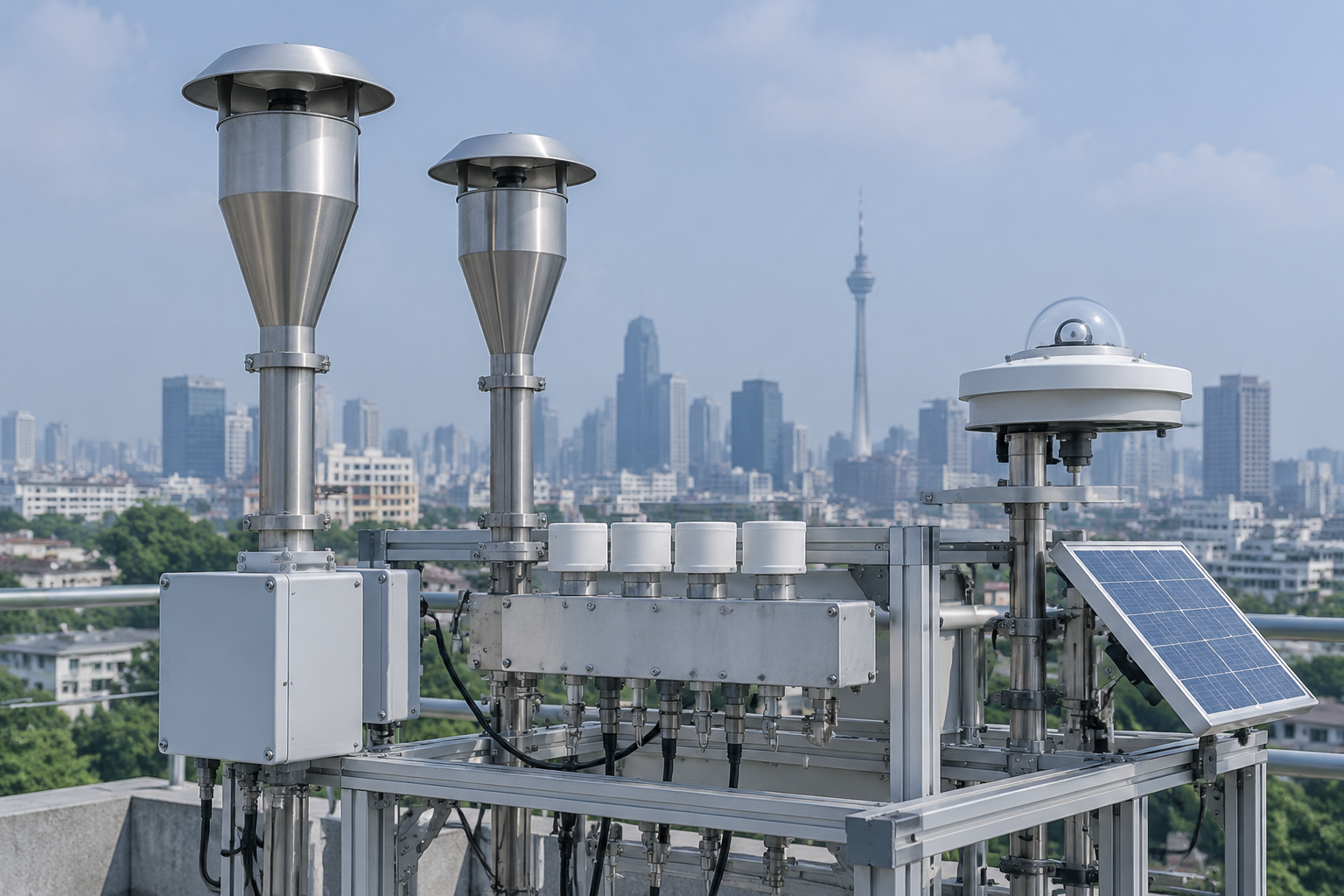
1. Coupling Design Across 18 European Chemical Weather Models
Operational regional chemical weather forecasting (CWF) links numerical weather prediction (NWP) meteorology with chemical transport models (CTMs) across hourly to multi-day forecast horizons. Kukkonen et al. (2012) systematically reviewed 18 European regional CWF systems, evaluating five structural choices that separate operational skill from offline hindcast performance.
Offline architectures write meteorological fields from an NWP driver at 1- to 3-hour intervals, risking temporal aliasing during rapid frontal passages or convective boundary-layer collapse. Online-coupled systems share prognostic advection and sub-grid turbulence at every dynamical time step, enabling aerosol direct and indirect radiative feedback onto surface temperature and mixing height. However, operational centers balance online physical fidelity against ensemble size, lateral boundary condition latency from global CTMs, and chemical data assimilation throughput.
2. Beijing PM2.5 Source Apportionment: Seasonal PMF Regimes
Receptor-based Positive Matrix Factorization (PMF) decomposes chemically speciated fine particulate matter into emission source factors without requiring bottom-up emission inventories as priors. Analyzing 121 daily urban PM2.5 samples collected across four seasons between April 2009 and January 2010, Zhang et al. (2013) resolved six physically interpretable source factors in Beijing: industrial pollution (28%), secondary inorganic aerosol (26%), soil dust (16%), coal combustion (14%), biomass burning (13%), and traffic plus waste incineration (3%).
Interactive Seasonal PMF Regime Diagnostic (Beijing 2009-2010)
| PMF Source Factor | Annual PM2.5 Share | Diagnostic Chemical Tracers | Dominant Seasonal Driver |
|---|---|---|---|
| Industrial Pollution | 28% | Zn, Pb, Cu, As, Mn metallurgical metals | Year-round regional advection from southern corridor |
| Secondary Inorganic Aerosol (SIA) | 26% | SO4^2-, NO3^-, NH4^+ water-soluble ions | Summer photochemical oxidation & humid aqueous uptake |
| Soil Dust | 16% | Ca, Mg, Al, Fe, Si crustal oxides | Spring northwest frontal resuspension & dust transport |
| Coal Combustion | 14% | Cl^-, SO4^2-, Pb, Se, organic carbon | Winter residential heating & shallow inversion trapping |
| Biomass Burning | 13% | K^+, levoglucosan / water-soluble OC | Post-harvest agricultural open burning & autumn peaks |
| Traffic & Waste Incineration | 3% | EC, Zn, Cu brake/exhaust tracers | Persistent urban corridor diurnal baseline |
Historical Citation Archive
Kukkonen et al. (2012): Operational, regional-scale chemical weather forecasting models in Europe
Comprehensive architectural synthesis of 18 operational European chemical weather forecasting models, detailing NWP-CTM coupling strategies, sub-grid boundary-layer parameterizations, lateral chemical boundary conditions, data assimilation, and multi-model ensemble forecasting. Canonical DOI: https://doi.org/10.5194/acp-12-1-2012.
Zhang et al. (2013): Chemical characterization and source apportionment of PM2.5 in Beijing
Quantified trace elements, water-soluble ions, and carbonaceous fractions across 121 daily Beijing PM2.5 samples (April 2009 to January 2010), resolving industrial (28%), secondary inorganic aerosol (26%), soil dust (16%), coal combustion (14%), biomass burning (13%), and traffic/waste (3%) contributions. Canonical DOI: https://doi.org/10.5194/acp-13-7053-2013.
Archived Topical Special Issues: Legacy Paths /special_issue8.html & /special_issue24.html
Historical special issue collections covering aerosol-cloud-chemistry campaigns, chemical weather forecast intercomparisons, and regional air-quality field intensives have been consolidated into this hub and the Historical Citation Registry. Original special issue indices are maintained by Copernicus at acp.copernicus.org.